
AI interfaces in relation to evolving digital marketing workflows, 2026
By 2026, AI interfaces will no longer be mere tools; they will become active participants in digital marketing workflows. From ideation and audience segmentation to dynamic optimization, AI is revolutionizing the entire process of planning, executing, and evaluating digital marketing campaigns. With increased automation, predictive analytics, and chatbot capabilities, digital marketers will have access to tools that facilitate faster, smarter, and more customized marketing processes. These changes will fundamentally alter established workflows, making them more agile and focused on achieving optimal results.
Table of Contents
-
Introduction: The dawn of AI-driven marketing
-
What are AI interfaces in digital marketing?
-
The development of digital marketing tools
-
The role of artificial intelligence in content creation
-
Role of artificial intelligence in marketing strategies
-
Social media management by AI
-
Making data analytics easier with AI
-
Automation: Saving time and increasing productivity
-
Skills marketers need in the Age of AI
-
AI in marketing challenges and limitations
-
Conclusion: The future of marketing
1. Introduction: The dawn of AI-driven marketing
The evolution of digital marketing in recent times is unprecedented compared to the previous two decades. There has been a significant transformation in digital marketing primarily due to one major factor – artificial intelligence (AI).
No longer is digital marketing driven by human intuition, manual operations, and trial-and-error processes. Rather, marketers have begun using AI-based platforms to generate content, create designs, conduct analysis, and forecast consumer behavior.
Regardless of scale, from solo entrepreneurs to big agencies, everyone is incorporating AI into their marketing process. The outcome? Efficiency, accuracy, and effectiveness.
This blog post will further investigate the impact of AI-based interfaces on digital marketing workflows.
2. What are AI interfaces in digital marketing?
AI interfaces are applications or interfaces that let you engage with AI through an easy-to-use platform.
Unlike coding or data science, AI provides immediate results right when you input your command, prompt, or upload files.
Some examples of AI interfaces:
Chat-based interfaces such as ChatGPT
Design platforms like Canva AI
Automation systems such as Zapier AI
Analytics platforms that utilize AI dashboards
Why are AI interfaces significant?
Requires no technical skills
Instant implementation
Profound insights within seconds
Drastically cuts down on effort
AI interfaces serve as a connecting link between human ingenuity and technological capabilities.
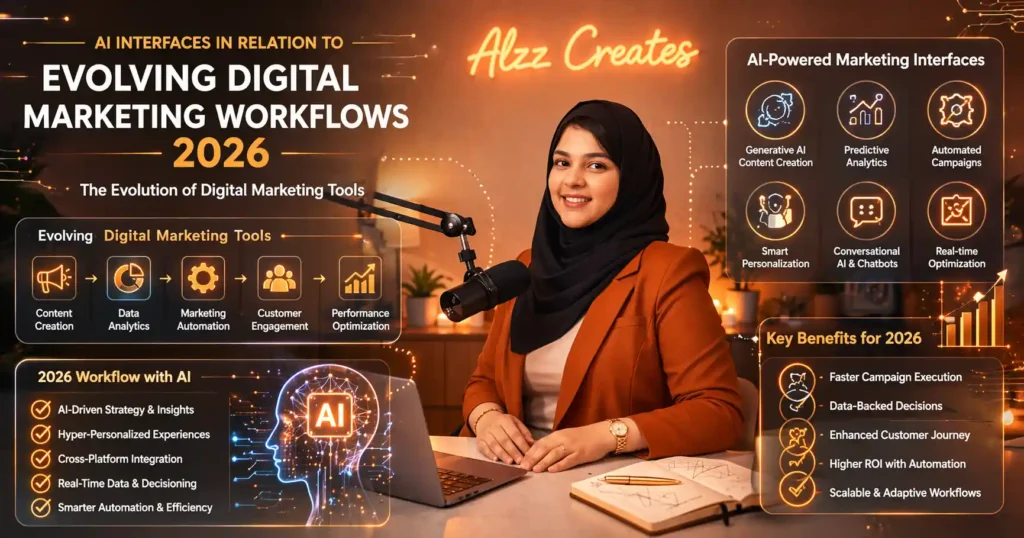
3. The development of digital marketing tools
In the past, digital marketers had to rely on a number of specific tools:
Photoshop for designing graphics
Excel spreadsheet for data analysis
Keyword research using manual tools
Post scheduling applications
All these tools contributed to a complicated and time-consuming process.
But now, all of it can be done by AI at once.
Previous workflow:
Concept → Research → Design → Composition → Posting → Analysis (Manual)
AI workflow:
Conceptualization: AI conducts research, designs graphics, composes content, and analyzes metrics within minutes.
The adoption of AI in digital marketing has made marketing:
Faster
Cost-effective
Scalable
4. The role of artificial intelligence in content creation
The field that AI is affecting the most is content creation.
Earlier, writing a post would take hours; nowadays, it can take just a few minutes.
AI can assist with:
Generating ideas for blogs
Creating posts for Instagram stories
Making advertisements and slogans
SEO-optimized articles
Generating headlines
Polishing the tone and grammar
For instance, a marketer can use AI to generate:
10 content ideas
Select the best idea
Write a complete blog post
Edit and publish
It does not mean that AI kills creativity; rather, it complements it.
The marketer becomes more like a content strategist than a writer.
5. Role of artificial intelligence in marketing strategies
The marketing strategy cannot be formulated just based on perceptions anymore.
AI can help marketers in analyzing:
Consumer behavior
Trending topics
Creating content calendars
Engagement performance prediction
For example, AI-based software can predict the following:
Best posting time
Best content type
Insights into consumer segmentation
In other words, the marketing strategy will be:
Data-driven + AI-enabled + human-created
Those who ignore the dangers of artificial intelligence in the competitive environment are already lagging behind.
6. Social media management by AI
Social media is one area that has been completely transformed by AI.
Now, AI is used for managing:
Instagram posts
Facebook ads
LinkedIn content
TikTok video scripts
The tasks include:
Generating hashtags
Writing captions
Editing video ideas
Trending formats suggestions
Instead of devoting many hours to planning posts, marketers are now using AI for generating a full weekly content strategy within minutes.
This allows marketers to spend more time on:
Branding
Creativity
Engagement
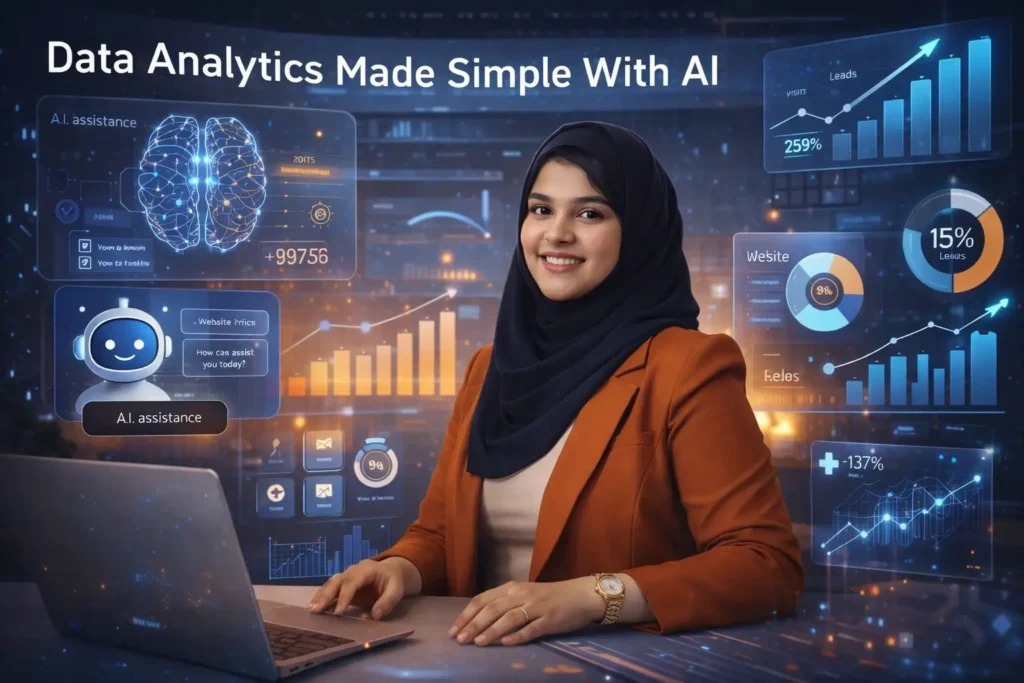
7. Making data analytics easier with AI
Before, analytics was very technical. But thanks to AI, it is much easier now.
With AI-driven analytics, marketers get:
Campaign performance tracking
Customer behavior trends
Sales predictions
Top-performing content identification
Instead of going through detailed reports, now marketers are getting:
Insights
Recommendations
Dashboards
Example:
Instead of writing “CTR is 4.3%,” AI says:
“Your Instagram reels perform 60% better than static posts.”
8. Automation: Saving time and increasing productivity
Automation is one of the most significant advantages of AI in marketing.
AI automation can:
Schedule posts automatically
Send emails at the right time
Answer customer inquiries
Create reports
This saves marketers time and enables them to concentrate on planning and being creative.
Thanks to AI, a marketer working alone today may do the job of a team.
This is what automation does for you.
9. Skills Marketers Need in the Age of AI
Despite being an advanced technology, AI requires human input.
For marketers to succeed in this age, they need new skills:
- Prompt engineering – How to ask the right questions of AI.
- Creativity – AI comes up with ideas, but people polish them.
- Data analysis – Understand AI-generated insights.
- Brand knowledge – Creating emotional bonds with the audience.
- AI software expertise – Using various AI software programs.
The future marketer is not only a creator but also a strategist, an AI operator, and a storyteller.
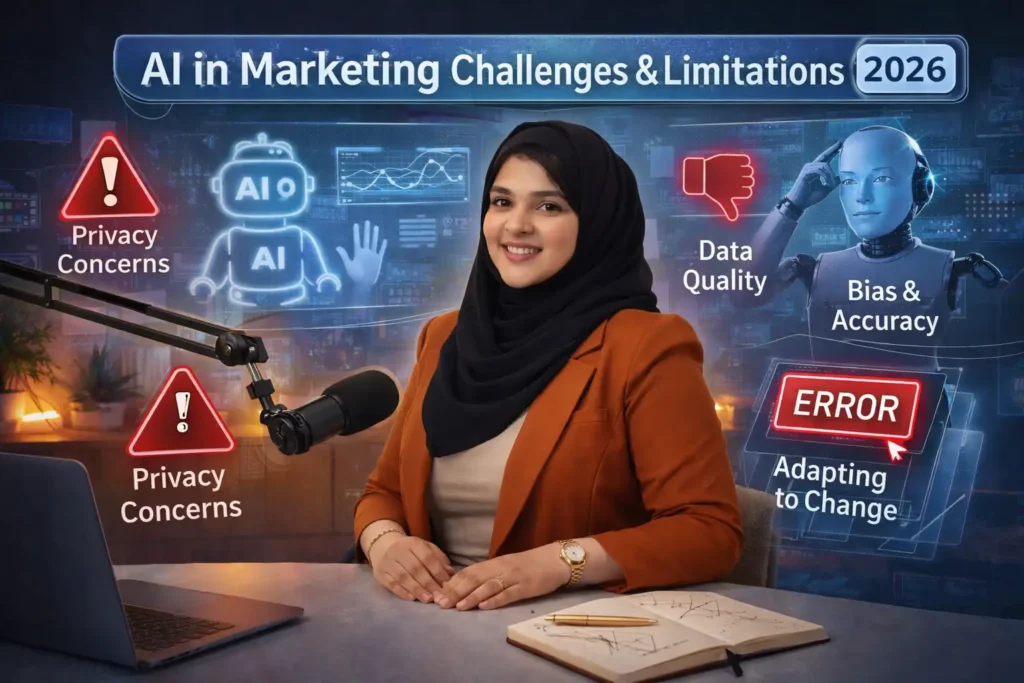
10. AI in Marketing Challenges and Limitations
Though AI is a potent tool, it has some issues.
Main challenges:
Cannot comprehend emotions
Tendency to produce generic content
Too much reliance on technology
Concerns about data security
Limitations to creativity
AI cannot substitute human feelings, stories, and experiences.
The best outcomes are achieved when people and AI work together.
11. Conclusion: The Future of Marketing Using Artificial Intelligence
AI is not expected, as we are already living with it today.
Marketing will use digital marketing, but strategy and creativity will be supplied by humans.
The better an individual learns how to adapt, the better he or she will do.
An individual who rejects AI technology will find it hard to compete.
Only those marketers who understand that there is one concept that will make them successful or unsuccessful are the ones.
AI will not try to take the place of marketers but will only help them be more efficient.